
Introduction
Television, television, television.
Watching TV and listening to the radio are part of everyday life. From news and business information to education and entertainment, we rely on these media. That is why it is unusual to find a home or office without at least one television.
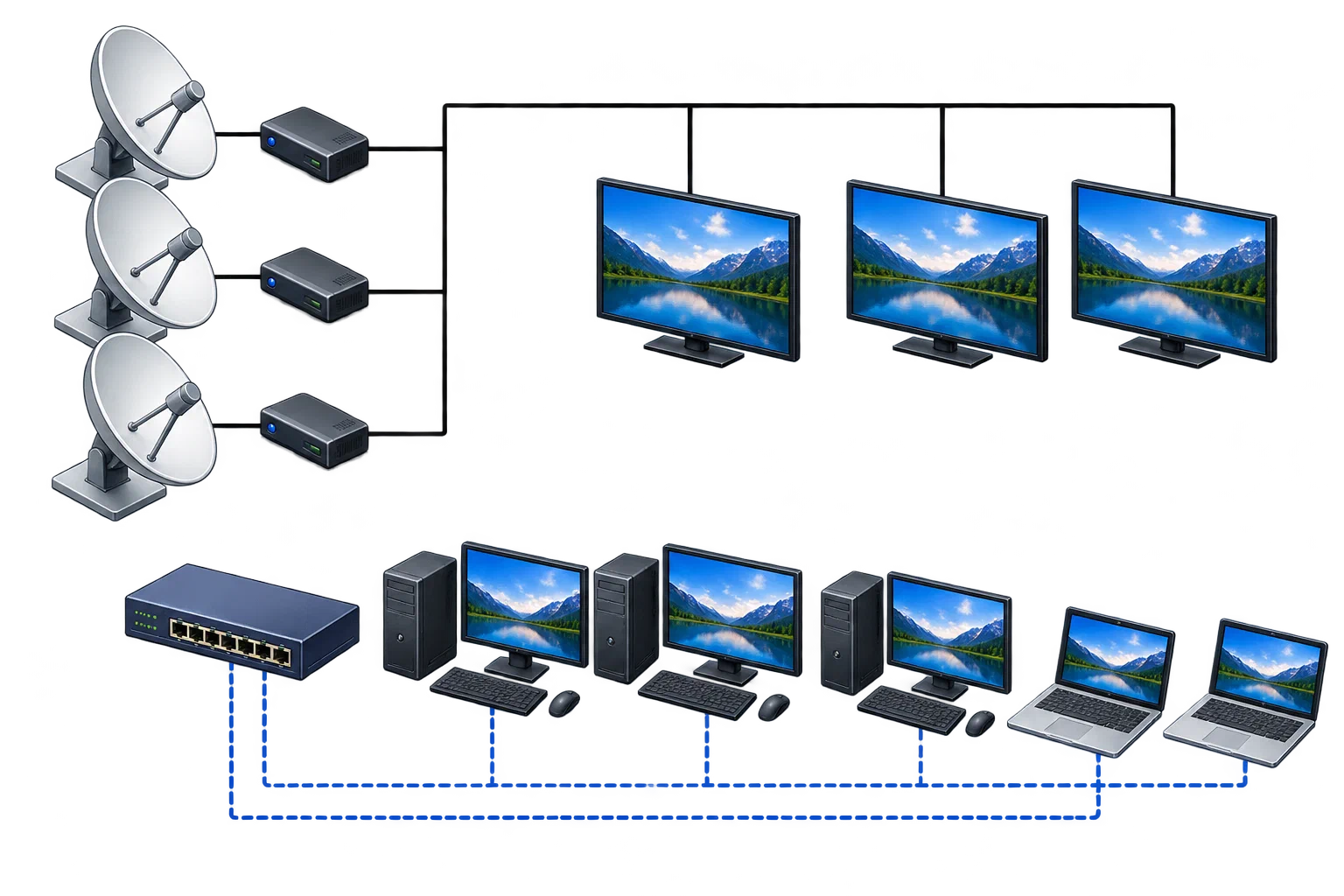
Buying a television and installing an antenna for a home is practical. Buying and installing many TVs and antennas in an organization, however, is difficult and expensive.
An organization cannot usually install an outdoor antenna for every television. It may also need to receive channels that are not broadcast terrestrially. In addition to buying TVs, the organization must run antenna cables to every location. This traditional arrangement is known as a master antenna television (MATV) system.
Problems with Traditional Systems
Traditional MATV systems have several drawbacks:
- Installing the antenna distribution system is expensive. It may require new coaxial cabling, additional construction work, and alterations to the building.
- Even when each office already has one or more computers, separate televisions must still be purchased to watch TV.
- If programs need to be recorded, video recorders and tapes must be purchased for each recording location, increasing both upfront and ongoing costs.
- Because not every channel should be available to every user, separate antenna cabling may be required for managers and other employees. For example, internal channels might be available to all employees while international channels are restricted to managers. This requires two or more separate MATV networks, which become difficult to manage when offices move.
- Apart from technical limitations, the number of channels distributed depends on the number of receiver inputs. For example, distributing 25 TV channels and 19 radio channels from Iran’s national broadcaster would require 44 receivers, along with numerous satellite dishes and LNBs—all of which are costly.
For modern organizations with many computers, these limitations make traditional MATV systems worth reconsidering.
A New Solution: LanTV—Television over the Network
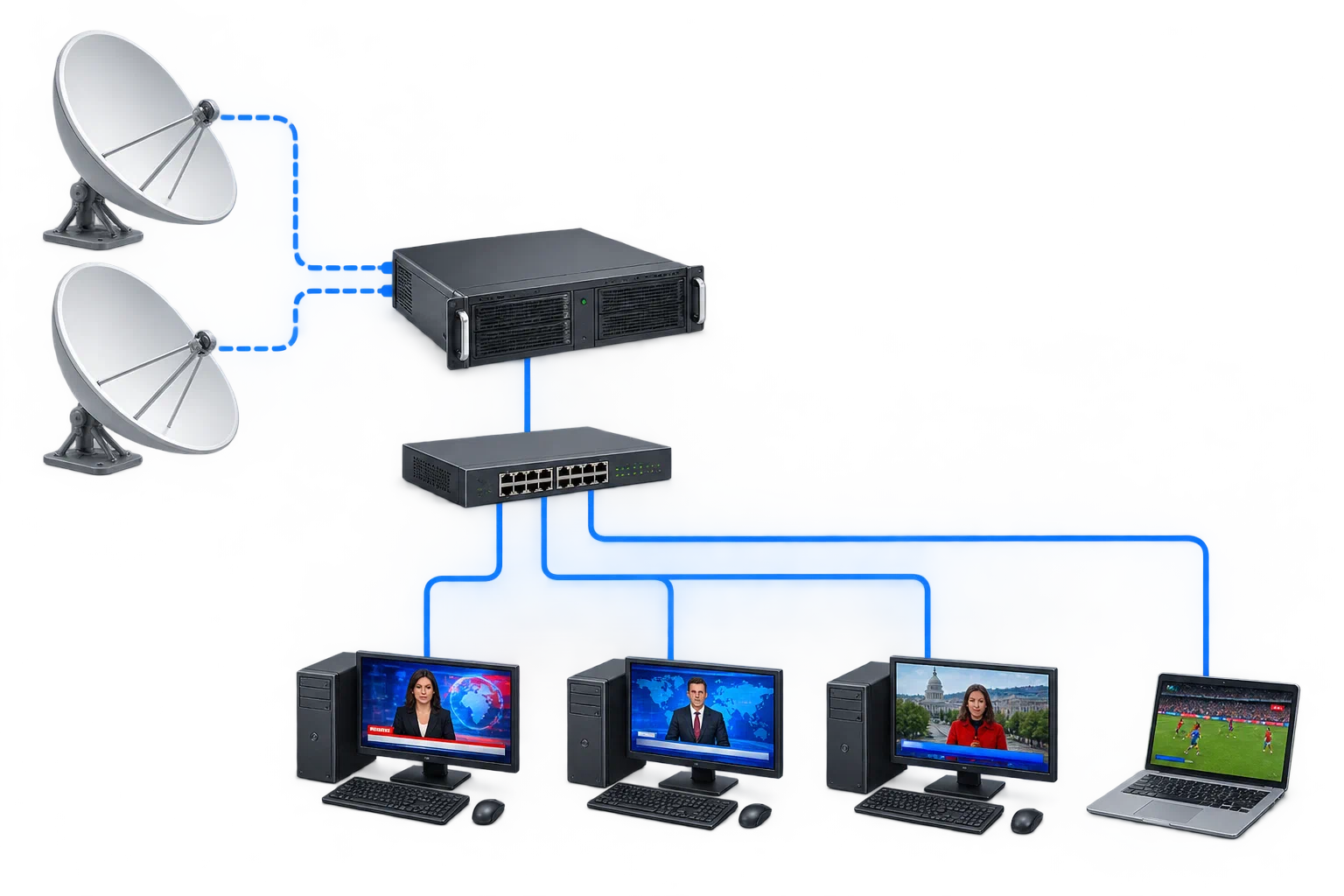
IDEANO’s LanTV solution addresses these problems with an innovative approach: distributing television over the computer network and letting users watch it on their existing computers.
LanTV Server connects directly to satellite dishes or a terrestrial antenna (for DVB-T digital terrestrial broadcasts) on one side and to the computer network on the other. It receives TV channels, streams them over the network, and manages their distribution.
This approach offers many advantages over the traditional solution:
- No separate MATV cabling is required because content travels over the existing network.
- There is no need to purchase televisions; existing computers can be used to watch TV.
- Dedicated video recorders are unnecessary because computers can also record programs. For example, three computers in an office can function as three TVs and three video recorders.
- One LanTV Server can serve the role of many receivers or set-top boxes and network streaming computers—supporting hundreds of receivers and client computers.
- User access can be controlled. Administrators can specify which channels each user may watch and during which hours, or temporarily disable a user. Traditional MATV systems do not provide this capability.
- Satellite content can be recorded on a dedicated recording server and stored for later access over the network, a feature unavailable in traditional MATV systems.
- The entire LanTV system can be managed from a single computer anywhere on the network, without requiring an administrator to be physically present at the equipment. A software videowall also eliminates the need for large banks of televisions to monitor incoming channels.
- Users can watch more than one TV channel at a time on a single computer.
- Unlike other computer-based TV solutions, LanTV does not re-encode the video. The content watched or recorded on a computer therefore retains the quality of the original satellite feed, without additional quality loss.
Network Distribution and Recording on Any Computer
As described in the LanTV architecture, LanTV Server sits between the satellite dish and LNB and the computer network. It converts the received satellite signal into digital data and distributes it over the network, while enforcing access permissions.
Each viewer only needs a computer connected to the network and the LanTV Client application.
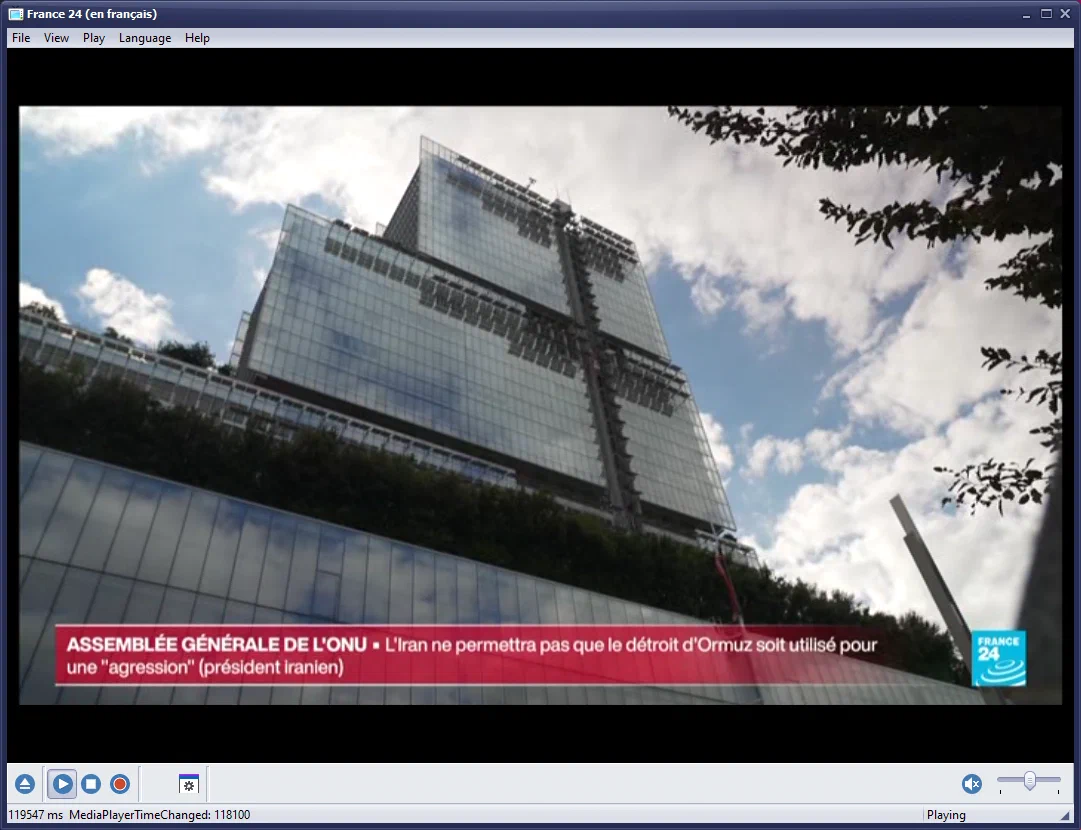
The client was designed to be as simple as possible, avoiding unnecessary complexity. Its interface is compact and straightforward, and users can learn it in minutes. In practice, no special training is needed: users select a channel from the list to watch it and click the Record button to record it.
Each program a user records is saved on that user’s computer and can be played back later. If the system administrator permits it, users can also watch multiple TV channels simultaneously on one computer—something that is not possible with a conventional TV and traditional MATV cabling.
Because LanTV transfers all content over the computer network, and virtually every organizational computer is already connected to one, separate cabling is unnecessary and the existing network infrastructure can be used efficiently.
Receiving Hundreds of TV Channels on a Single Device
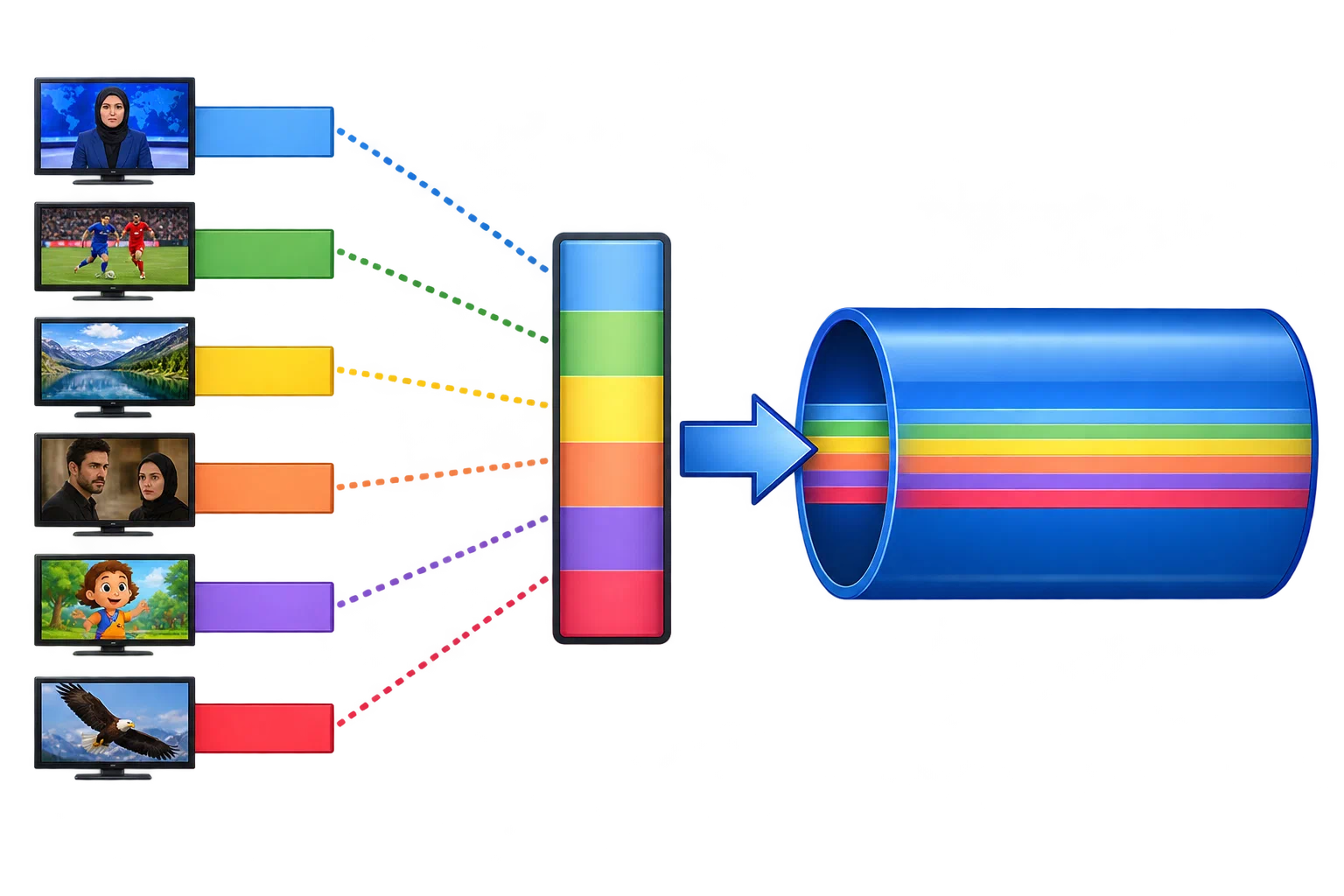
A key capability of LanTV is receiving and separating all programs carried on the same frequency through a single device input. With up to 28 inputs per device, a LanTV unit can receive hundreds of TV and radio channels.
This works because of the way MPEG-2 and AVC programs are transmitted. In DVB-S2 satellite and DVB-T2 terrestrial digital broadcasting, each frequency typically carries several channels together to use bandwidth efficiently. This arrangement is known as multiplexing.
For example, one S2 frequency used by Iran’s national broadcaster on the Badr satellite (26° east) carries TV channels 1 through 5, Khabar, Quran, Amoozesh, Jam-e-Jam, Pooya, Shoma, Mostanad, Bazar, Namayesh, i-Film, Varzesh, Salamat, Nasim, and Press TV, together with a number of radio channels.
LanTV can receive all channels transmitted on that frequency through a single input. Each input can be tuned to a different frequency and satellite independently of the others.
High Reception Capacity and Lower Equipment Costs
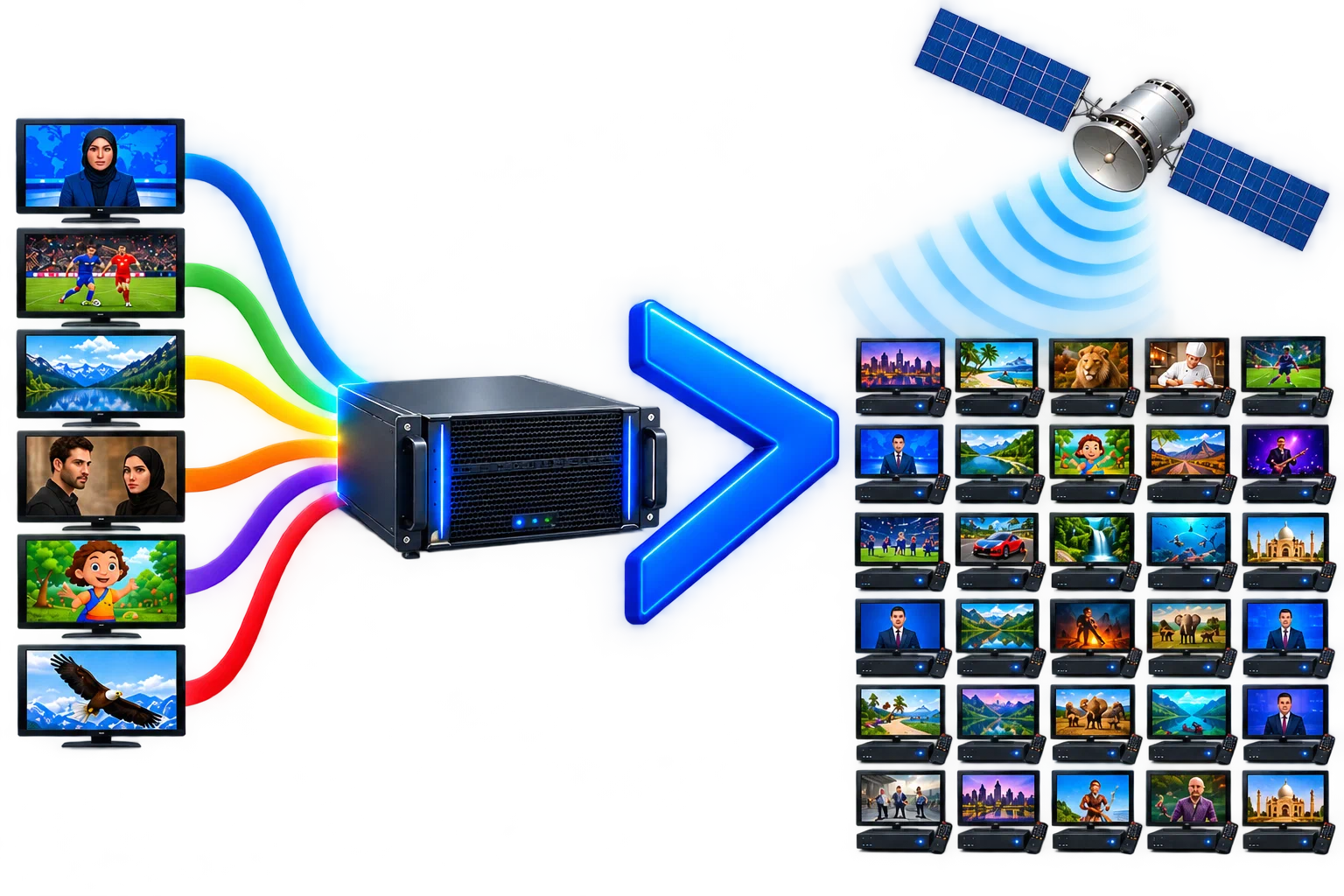
For example, if one of the 28 independent frequency inputs on a LanTV Server is tuned to the frequency described above, it can receive 19 TV channels and 15 radio channels at the same time. That is equivalent to 34 satellite receivers operating together—and the device still has 27 unused inputs that can be tuned to other satellite frequencies.
Receiving so many programs on a single device can significantly reduce equipment costs, space requirements, power consumption, and—most importantly—management overhead. It is easy to see the benefits of replacing dozens of receivers and streaming computers with one LanTV Server.
Comprehensive User Management
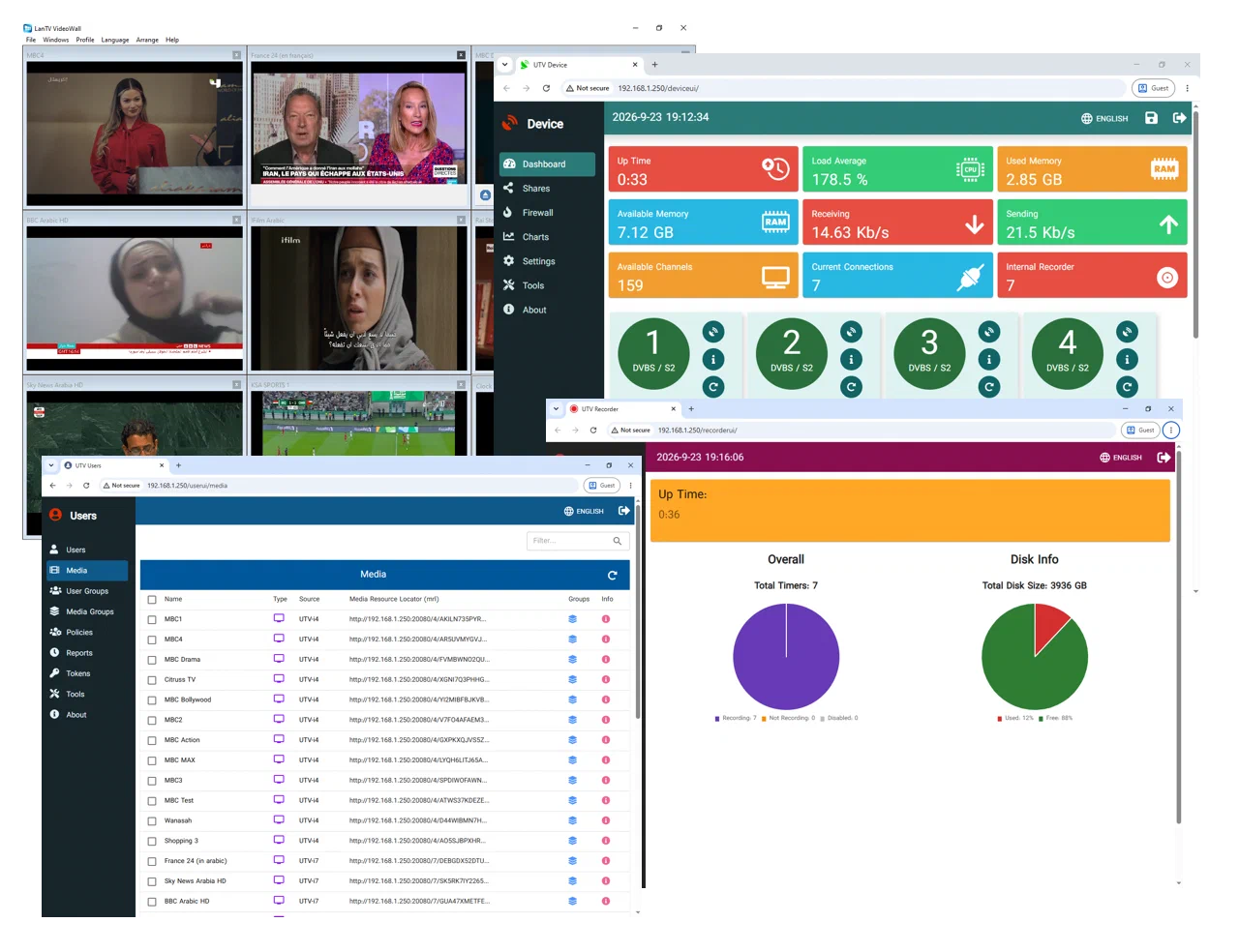
One of LanTV’s major advantages over traditional MATV systems is its broad and flexible control over how the system is used.
A traditional MATV system cannot control which channels a user watches or report what each user is currently watching. Because the signal is distributed over a cable, it is available to anyone connected to that cable, whether authorized or not.
With LanTV, the system administrator can assign channel access to individual users or groups. Administrators can also see which channel each user is watching and temporarily disable or re-enable a user when necessary.
Administrators can also specify the times during which users are allowed to watch particular channel groups.
Given the nature of traditional MATV systems, these capabilities are not available in those systems, even in principle.
Centralized Recording
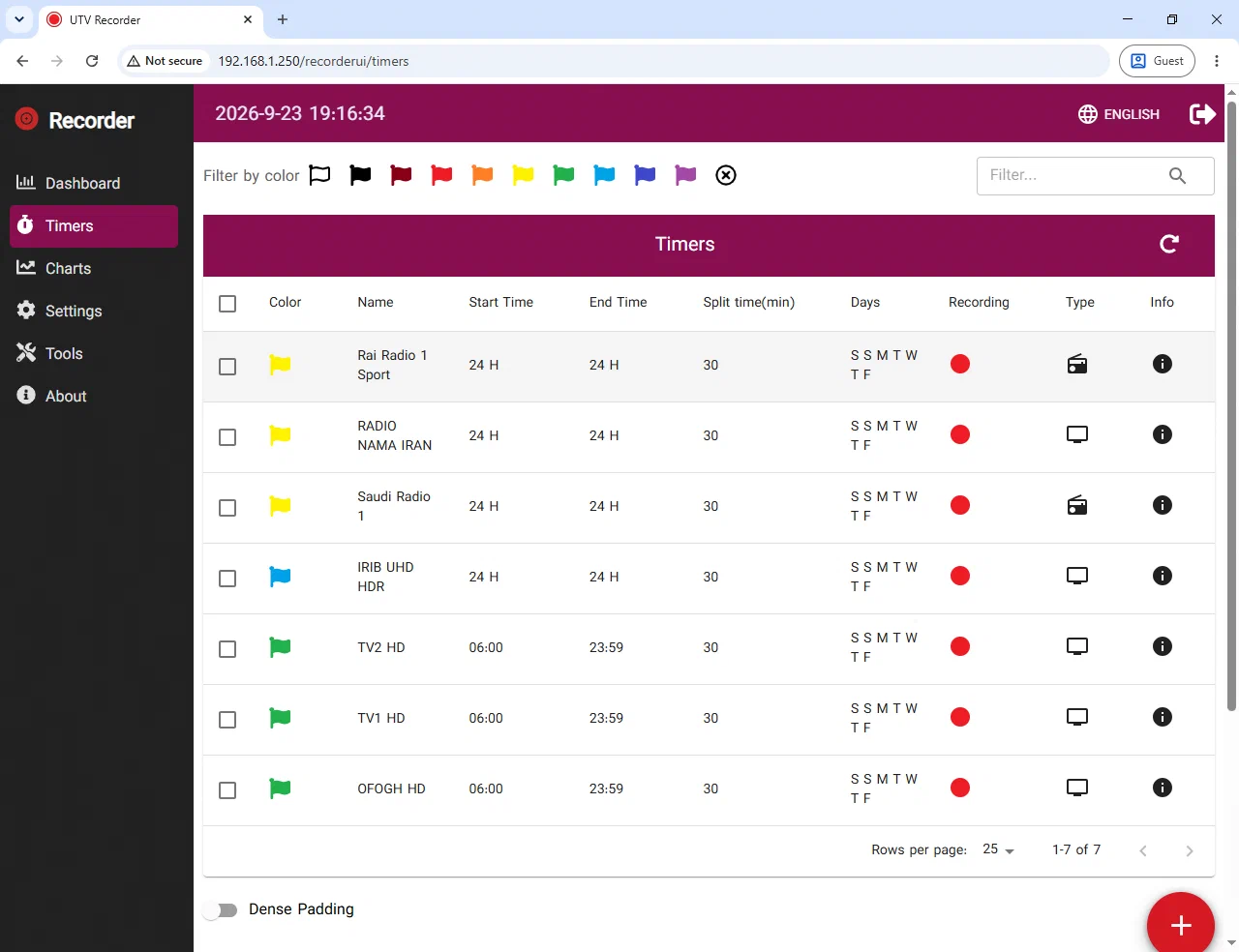
In addition to recording on each user’s computer, organizations sometimes need to record a program for many people to access.
For this purpose, LanTV includes LanTV Recorder, which can record dozens of TV and radio programs simultaneously.
The application supports scheduled recording. For example, an administrator can collect recording requests from users and enter them into a schedule. When the scheduled time arrives, the application records each program automatically. The resulting recordings can then be made available to users over the network.
This ensures that a program is not missed simply because a user was unavailable to watch it live.
Scheduled recording is especially useful in monitoring centers that need to record many satellite channels.
LanTV Recorder is a Windows application and can run on various versions of Windows Server. It is managed through a dedicated control interface. The recording hardware can range from a fast desktop computer for less demanding workloads to a server with several terabytes of storage. As a rule of thumb, one terabyte of disk space can hold approximately 500 hours of recorded satellite TV, assuming an average audio/video bitrate of 4 Mbps.
Simple, Centralized System Management
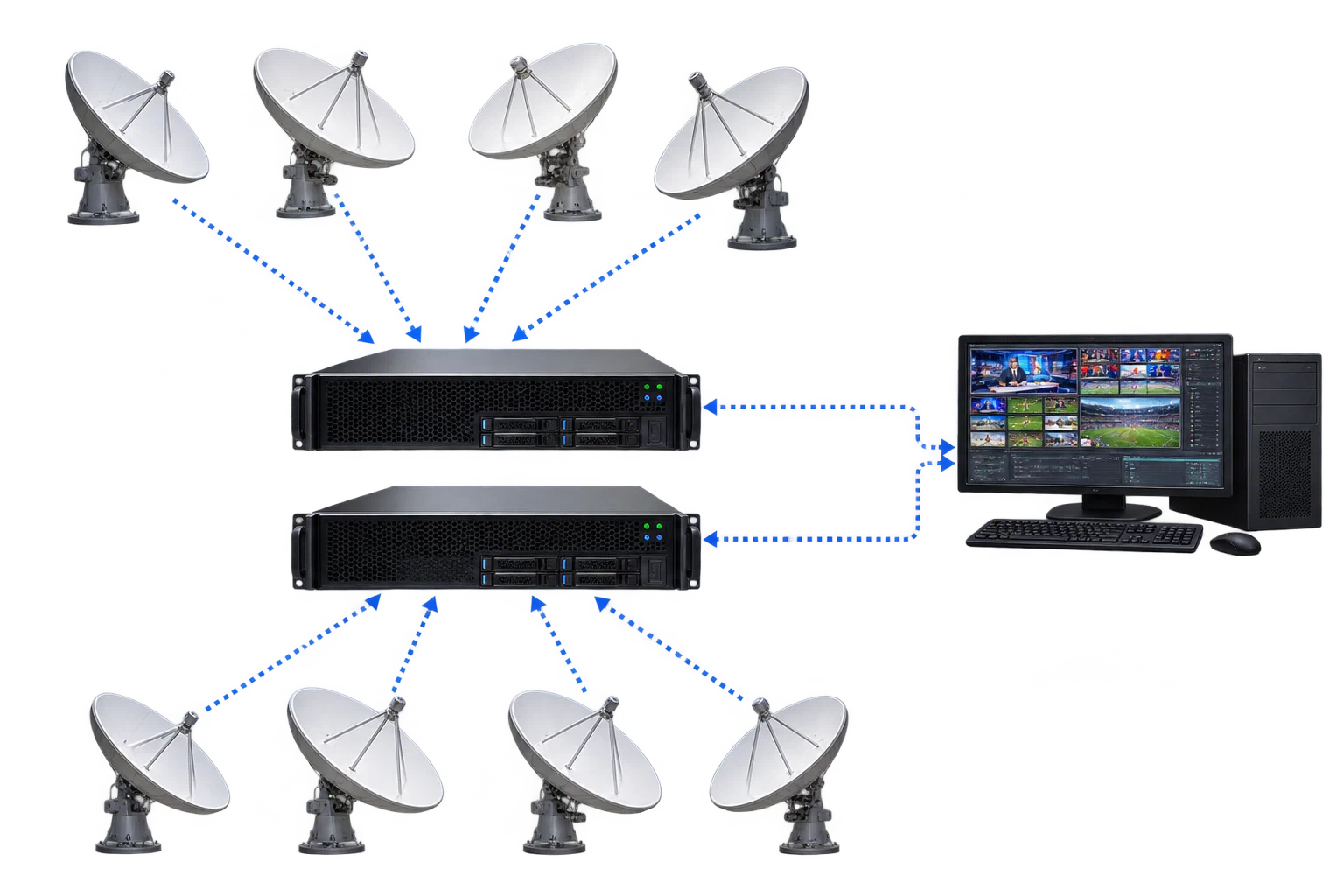
A major benefit of LanTV is that the entire system can be managed centrally from anywhere on the network. No dedicated control room is required: any computer with the LanTV management application can manage multiple LanTV servers.
The control application provides access to system functions, from restarting LanTV servers and managing user accounts to checking the signal strength received by each device. This makes system administration much simpler.
Traditional MATV installations often require a bank of televisions in one location to monitor incoming channels and check picture quality. This arrangement is known as a videowall. LanTV provides a software-based videowall: the management computer can display and record several TV channels simultaneously. This reduces the cost, installation effort, maintenance, and space required for a physical videowall while offering greater flexibility.
High Reliability
Reliability is essential for any professional system. It depends on quality components, well-designed software, and a stable operating system. LanTV combines quality hardware, carefully designed and tested software, and—most importantly—Embedded Linux to deliver high reliability.
Linux is widely recognized as a strong operating system for servers and systems that require high availability. Servers have been known to run for more than a year without restarting or encountering problems. Linux is also known for efficient hardware utilization and security.
Another advantage of Linux is that its components can be separated. Unlike Windows, which traditionally relies on a graphical environment, Linux can run without a desktop interface when one is not needed, as on a LanTV Server. This allows the system to use RAM, CPU, and other hardware resources more efficiently, contributing to reliability.
The Linux system on LanTV Server is also embedded: unnecessary components have been removed, and the operating system and application are compressed into less than 50 MB of memory. This efficient use of hardware helps the system run reliably over extended periods.
Turnkey Design
The LanTV architecture—and especially the LanTV Server appliance—was designed to be easy to use. This principle applies throughout the system, from the control application to the server itself.
An important design goal is to make the device resilient to environmental events, such as power interruptions or accidental power cycling.
As described above, LanTV Server uses Embedded Linux, customized to reduce vulnerability to power interruptions. The customized operating system also reduces boot time to just a few seconds.
Setup is straightforward: take the device out of the box and power it on. The control application can then be used to configure it.
Ease of use also extends to the management tools. Although the server itself runs Embedded Linux, the management and client applications run on Windows, so users can work in a familiar environment without having to learn a new operating system.
Multilingual Design
Because user convenience and system manageability are top priorities, all LanTV applications are designed to support multiple languages. For example, the LanTV software suite is available in Persian and English, and can be adapted to additional languages with minimal effort.